

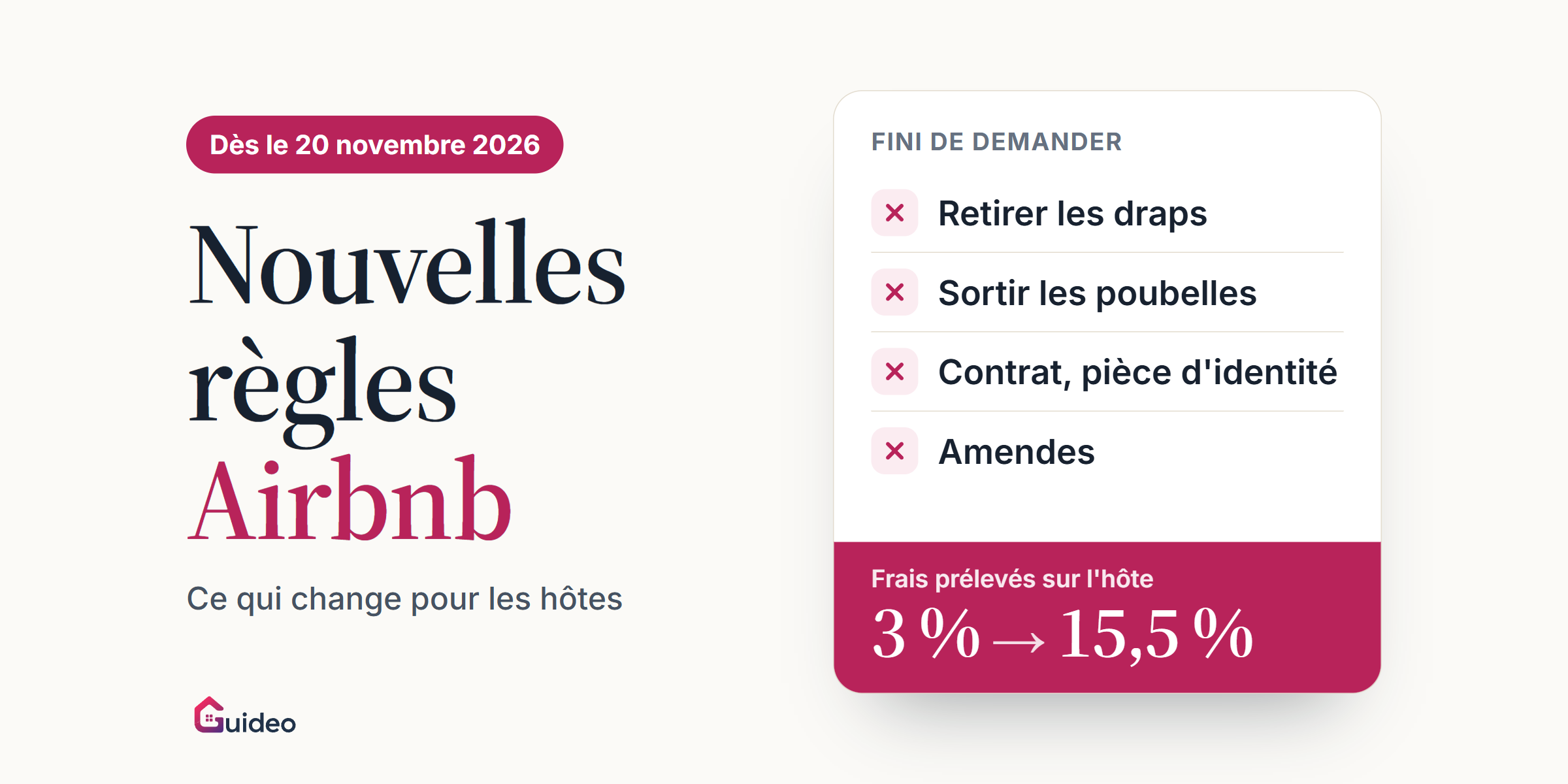
On 20 October 2026, Airbnb announced a major crackdown on what hosts can ask of their guests. No more making the bed or taking out the rubbish; no more standard contracts, photocopies of ID or fines either. These new Airbnb rules apply to bookings made from 20 November 2026, following a sharp rise in the fees charged to hosts. Here’s what’s actually changing, what you need to update in your listing, your messages and your welcome booklet, and how to minimise the impact of the fees.
📌 What’s changing, in brief
- Rules: everything must be included in the ‘House Rules and Requests’ section of the listing. No further information may be provided via message, notice or in person.
- Cleaning: it is forbidden to ask guests to carry out tasks that are time-consuming or normally carried out by a cleaner.
- Fines: no penalties may be imposed on the traveller.
- Contracts: generally prohibited, except in four specific cases.
- Personal data: no collection of identity documents, contact details or bank details, subject to exceptions.
- Access and apps: no third-party apps or compulsory registration required to enter the accommodation, subject to exceptions.
- Fees: the fee charged to hosts rises from 3% to 15.5% in most cases, whilst travellers no longer pay any service fees.
📄 Terms and Conditions, Terms of Service, policies: what are we talking about?
There’s been a lot of talk about the ‘new Airbnb Terms and Conditions’, but the main text – the Terms of Service – wasn’t rewritten in October: it was last updated on 5 February 2026. The changes introduced in November relate to two community policies, which hosts must comply with:
- House Rules and Reasonable Requests;
- Restrictions on contracts and other conditions imposed by the host, which replaces the former policy on off-platform activities.
These apply to bookings made from 20 November 2026 onwards, regardless of the date of the stay. A booking made before this date remains subject to the old rules, even if the traveller arrives in January.
The change to service fees is separate from these two policies. We’ll come back to this below.
🏠 The 7 standard house rules
The house rules now consist of seven standard rules, all set in the same place within the listing editor:
- Maximum number of guests
- Quiet hours
- Events
- Pets
- Smoking (including vaping and e-cigarettes)
- Commercial photographs
- Lock the property when you leave, stating where the keys should be returned
Everything else is considered a request, to be entered in the same section, under a dedicated heading ‘Before departure’. The difference matters: guests must comply with the house rules, whereas they are simply asked to follow requests.
🧹 What else you can ask for on departure
A request must be reasonable: no tasks that take up time or energy, nor any work usually carried out by a cleaner. Airbnb gives these examples:
❌ What you can no longer ask for
- Washing or putting away the crockery
- Removing bed linen or putting a wash on
- Taking rubbish out of the property
- Turning off equipment mentioned in the listing, such as air conditioning
✅ What you can ask for
- Leave used crockery in the sink
- Gather up the dirty towels
- Sort rubbish and recyclables into the bins inside the property
- Switch off the air conditioning when you leave
The dishwasher is not mentioned. To be on the safe side, use ‘in the sink’, the only phrasing approved by Airbnb. For points relating to your specific situation, the platform takes into account the type of accommodation and the local context: examples include limiting shower time during periods of drought and using pet-proof bins in a region with bears.
Template requests to copy into ‘Before departure’
To help us prepare for the next guests, please:
🍽️ Place used crockery in the sink
🧺 Gather used towels in the bathroom
♻️ Sort rubbish and recyclables into the bins in the kitchen
💡 Switch off the lights, heating and air conditioningWe’ll take care of the rest!
The locking procedure and where to return the keys do not need to be listed here: these are covered by the seventh standard rule.
💶 Fines and penalties: that’s a thing of the past
You can no longer include penalties in your listing, for example for a messy property or a late checkout. There’s just one caveat: if a housing association or local authority can impose a fine on you, you can inform guests of this in the relevant section of the listing.
The cost of cleaning must therefore be included in your cleaning fees, and any damage must be handled via Airbnb’s tools: AirCover for hosts and the Resolution Centre. If your cleaning provider now has to strip the beds or empty the bins, discuss the estimated time required with them and adjust your flat rate if necessary.
📝 Tenancy agreements: only four exceptions
You can no longer require a signed contract, except in the following cases:
- a legal obligation or a condition of the owners’ association rules;
- access to optional equipment (Airbnb cites golf buggies);
- a stay of 28 nights or more;
- Airbnb Luxury accommodation.
A permitted contract can be uploaded in the ‘Contracts’ section of the listing settings. It must not contain any personal data, and Airbnb states that it does not enforce compliance on your behalf.
And in France? Article L. 324-2 of the Tourism Code requires that an offer or contract for a holiday let be in writing and specify the price and a descriptive account of the premises. Airbnb has not specified whether this provision allows for the ‘legal obligation’ exception. Before importing a contract on this basis, check with Airbnb or a legal professional.
🪪 Identification documents and personal data
During the booking or the stay, you may no longer request contact details, identity documents, bank details, background or credit checks, or biometric or health data.
- Check-in verification: you may check an identity document in person if you have stated this in advance, without keeping a copy, whether on paper or digitally.
- Legal obligation: collection remains permissible if required by law, a co-ownership rule or for the security of the building. State in the advert what you are requesting and why, collect only what is strictly necessary, then secure and delete this data.
And in France? Foreign travellers are still required to complete an individual police registration form, in accordance with Article R. 814-1 of the CESEDA, which applies in particular to landlords of furnished holiday accommodation and guesthouses. This article refers to having a form completed and signed, not to copying an identity document. Mention this requirement in your advert.
📲 Apps, Wi-Fi, reviews: other points to check
- Access to the accommodation: no third-party apps or compulsory registration. An app-controlled lock is still permitted if you offer an alternative means of entry on request.
- Wi-Fi: no login portal requiring an email address or other personal information, except for hotels or hotel complexes, or in exceptional circumstances.
- Reviews: no requests for reviews or questionnaires on another website, except for hotels.
- Recommendations: you may recommend businesses and activities, provided this is optional and you disclose any direct financial benefit.
- Paid options: breakfast or other optional services may be described in your listings. However, any facilities mentioned in the listing must not be charged for in addition to the price displayed at the time of booking.
📖 And what about your welcome booklet?
Airbnb doesn’t mention welcome booklets in these guidelines, but its instructions are clear: no rules should be set out anywhere other than in the dedicated section – neither in your messages nor on signs within the accommodation. Our interpretation is therefore straightforward: the booklet provides information, whilst the listing sets out the rules.
Airbnb also classifies ‘concierge apps’ as authorised optional apps, which corresponds to a booklet that can be viewed freely without registration.
✅ What the booklet can continue to do
- Explain how the accommodation works: Wi-Fi, heating, hobs, washing machine
- Provide practical information: local waste sorting, collection days, location of bins for those who wish to know
- Share your favourite places and recommendations, mentioning any financial benefits
- Reiterate your rules and requests, using the same wording as in the advert
❌ What’s best to remove
- Any rules or instructions not mentioned in the advert
- The pre-departure chores from the old list: changing bed linen, doing the washing, putting out the rubbish
- Any mention of penalties or deductions
- A link directing guests to a review on another site or a questionnaire
For reminders during the stay, Airbnb provides your house rules as a quick reply: this is the safest method. And keep your arrival instructions within Airbnb: the booklet should be a convenience, never a condition for entry.
With Guideo, these updates take just a few minutes. You edit the section and the QR code stays the same – no need to reprint. Don’t forget your departure checklist either – make it optional and tailored to your requirements. Guidy, the guest guide assistant, responds based on its content: an up-to-date guest guide means an up-to-date assistant too.
💸 Airbnb fees: from 3% to 15.5% for hosts
Airbnb is switching its hosts to a single service fee: 15.5 per cent for most of them, deducted in full from your payment, compared to 3 per cent under the old split-fee system. According to the specialist press, these fees have applied to French hosts since 13 October 2026. They only apply to new bookings.
In return, travellers no longer pay any service fees. MoneyVox gives this example for a one-night stay costing €100:
- Before: the traveller pays €115, you receive €97.
- Now, with the price unchanged: the traveller pays €100, you receive €84.50.
To recoup your €97, you’ll need to list the room at around €115 per night. The traveller then pays roughly the same as before, but your declared income increases, which may affect your tax liability and social security thresholds. Discuss this with your accountant. Also bear in mind your cleaning costs: these are included in the calculation.
Direct bookings, with no commission
With these costs factored in, every booking secured outside the platform is worth more. Guideo’s direct booking service charges no commission: the traveller pays by card via Stripe, and only Stripe’s fees apply – 1.5% + €0.25 for a standard EEA card, and more for a premium or international card.
For a stay costing €500 paid by the traveller, excluding the Guideo subscription:
- Via Airbnb (15.5% fees): you receive €422.50.
- Directly via Guideo, standard EEA card: you receive €492.25, which is €69.75 more.
- Directly through Guideo, with an international card (3.15% + €0.25): you receive €484.
However, booking directly does not replace the visibility offered by Airbnb, and AirCover does not apply in this case. It is up to you to attract guests and manage cancellations, damage and tourist tax.
⚠️ Do not divert your Airbnb guests
The Terms of Service prohibit requesting or accepting a booking or payment outside the platform, and payments for current, future or recurring bookings must go through Airbnb. Therefore, do not offer direct bookings to a traveller you’ve met on Airbnb, either via message or in their guestbook.
Reserve direct bookings for your own channels: Google, social media, word of mouth, business cards. The Guideo showcase brings together your properties behind a single link that you can share via these channels. If you enable direct booking on a listing, keep it for those guests, and send your Airbnb guests a listing without this option.
✅ The checklist before 20 November
- Set the seven standard rules in your listing.
- Move your house rules to the ‘House Rules and Requests’ section and rewrite them using the template above.
- Go through your scheduled messages, posters and guest guide: remove anything that isn’t in the listing.
- Remove any references to fines or penalties.
- Remove any contracts that do not fall under the four exceptions.
- Stop asking for photos of ID documents. If you check identity on arrival or if you complete a police registration form, state this clearly.
- Check that nobody is required to create an account or install an app to enter.
- Notify your cleaning service provider and review their visit times.
- Recalculate your prices and cleaning fees to include the 15.5 per cent charge.
❓ Frequently asked questions
What are the consequences for a host who fails to comply?
Regarding the community guidelines, non-compliant requests are flagged in the listing tool and you will be notified by email, with the option to appeal. If the problem persists, a warning may appear on the listing, for example ‘includes cleaning requests’, and its visibility may be reduced. Regarding contracts and personal data, Airbnb also provides for the suspension or removal of listings, or even the account, in the event of a repeat offence.
Can I present the removal of bed linen as an optional extra service?
Airbnb does not make this distinction: all requests must be reasonable, and removing bed linen is listed among the examples to avoid. On Airbnb, the safest option is simply not to ask for it at all.
What if a guest does not comply with the house rules?
Contact Airbnb. The platform states that in the event of a breach during the stay, or if the guest announces before arrival that they will not comply with a rule, the booking may be cancelled at no cost or consequence to you. It may also take action against guests in the event of repeated or serious breaches.
Can I ask an Airbnb guest for a security deposit?
Generally speaking, no, and this isn’t a rule that came into effect in November. Airbnb states that most hosts cannot charge a security deposit or pre-authorise a card. Exceptions apply to certain hosts connected via software and to hotels, provided that the security deposit is shown in the fees section before the booking is made. For direct bookings made outside of Airbnb, these rules do not apply, and Guideo’s online security deposit remains an option.
Do these rules apply to Booking or Abritel?
No, they only apply to Airbnb bookings. If you list on multiple platforms, the simplest approach is to maintain a single version of your guidelines, aligned with the strictest requirements.
🚀 An up-to-date guest guide by 20 November
These rules refocus the welcome on what a guest booklet does best: providing clear information, without imposing anything. With Guideo, you can maintain a clear guest booklet, translated into the traveller’s language and editable at any time. And for travellers booking through your own channels, direct bookings are commission-free, excluding Stripe fees.
👉 Try Guideo free for 30 days — no credit card required.
This article summarises the policies published by Airbnb in October 2026. It does not constitute legal advice. Please refer to the official texts, which are subject to change: Significant changes to the House Rules, House Rules and reasonable requests, Limitations on contracts and other conditions imposed by the host.