

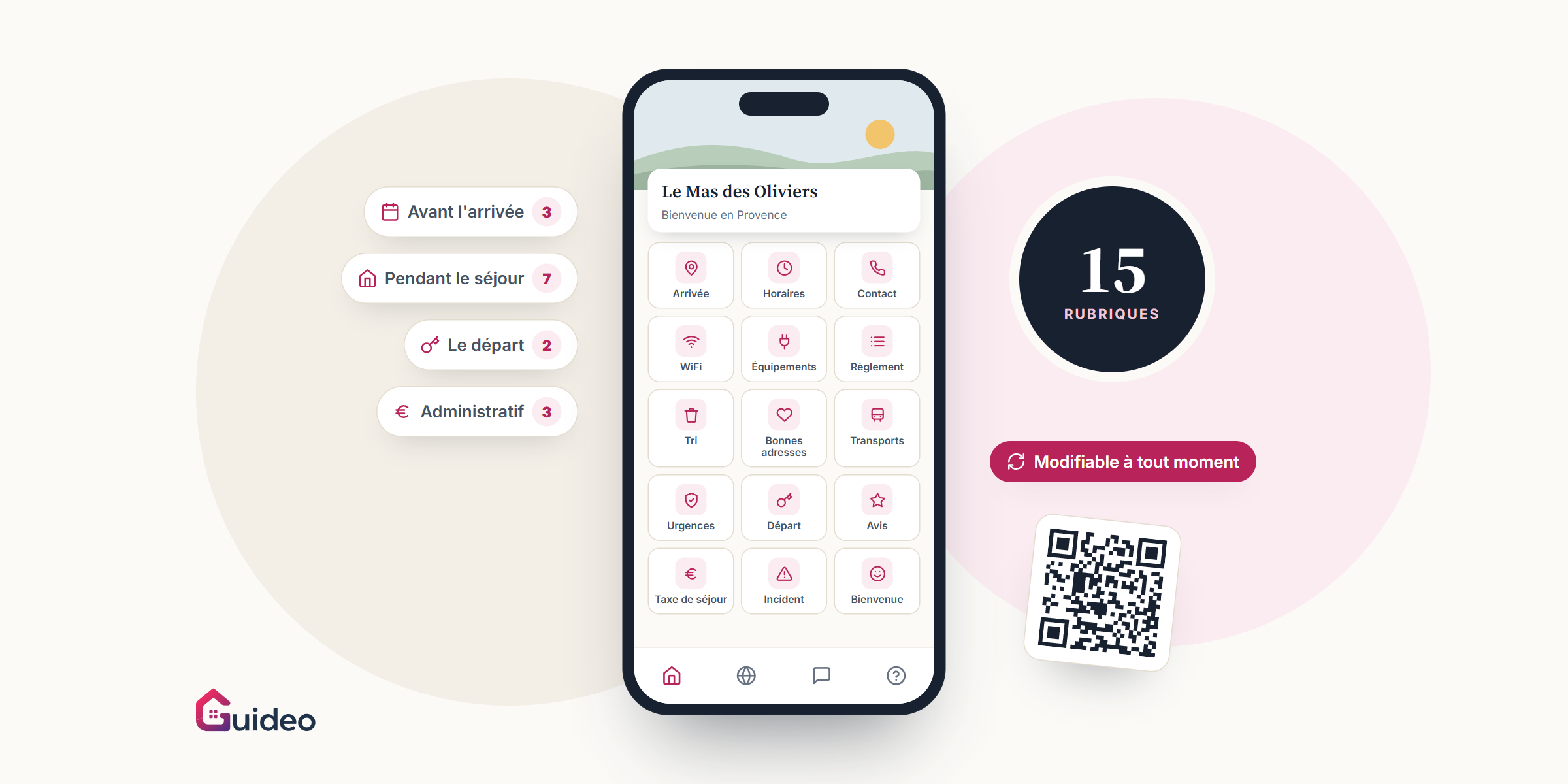
What should you include in a welcome booklet? This is the first question you’ll ask when you’re just starting out, and the answer determines whether your booklet will actually be read or ignored. Here is the complete list of 15 sections, organised by stage of the stay, with details for each on what’s essential and what’s unnecessary.
🧳 Before arrival: what guests look for first
1. Arrival instructions
Exact address, directions from the station or motorway, where to park, how to collect the keys (key box, smart lock, hand-delivered). Add a photo of the front of the property and the entrance: this is the detail that prevents calls like ‘I’m right outside, but what am I looking for?’.
2. Check-in and check-out times
State the times, but also the procedure for requesting an early arrival or late departure. If guests check in themselves, set out each step in detail: our article on self-check-in covers the subject in depth.
3. Your contact details
Telephone number, times when you’re available, and your preferred method of contact (text message, WhatsApp, phone call). Specify who to contact in an emergency if you’re unavailable.
🏠 During the stay: the heart of the booklet
4. Wi-Fi
Network name, password, location of the router and how to restart it. This is the most frequently consulted section: put it right at the top.
5. The equipment guide
For every appliance that might raise questions (washing machine, dishwasher, hob, oven, heating, air conditioning, TV, coffee machine, barbecue, swimming pool, hot tub): where it is located, how it works, and common mistakes to avoid. Three lines per appliance are sufficient.
6. House Rules
No smoking, quiet after 10 pm, pets, maximum capacity, use of outdoor areas. Word them positively and keep it brief: five rules that are read are better than twenty that are ignored.
7. Rubbish bins and recycling
Location of bins, collection days, local recycling rules. An often-overlooked section, and a major source of friction at the start of a stay.
8. Your local recommendations
Tried-and-tested restaurants (including your favourite dish), bakeries, markets, supermarkets, activities, beaches or walks, ideas for rainy days. This is the section that generates the most compliments in the comments. Keep it personal, not exhaustive.
9. Transport and services
Buses, railway station, taxis/private hire vehicles, chemist’s, GP, cash machine. Include walking times from the accommodation.
10. Emergencies and safety
112, 15, 18, poison control centre, your contact number. Location of the fire extinguisher, circuit breaker, water main and first-aid kit. Morally obligatory, and sometimes required by law.
👋 Departure
11. The check-out checklist
Cut-off time, where to leave the keys, what you expect (run the dishwasher, take out the rubbish, close the windows), and what you don’t expect. A clear checklist avoids misunderstandings about cleaning.
12. The invitation to leave a review
A simple message: ‘If you enjoyed your stay, your review would be a huge help to us.’ Placed in the guest booklet, it’s read at just the right moment, just before departure.
📄 Administrative sections
13. Tourist tax and registration number
The amount of the tourist tax and, in the relevant local authorities, the registration number of your self-catering accommodation must be brought to the traveller’s attention.
14. Instructions in the event of an incident
What should you do in the event of a breakdown, breakage or damage? Setting out the steps to follow helps to ease stress and saves you time. (Guideo booklets include a reporting form directly within the booklet.)
15. The welcome message
Saved for the end of this list, but placed first in your booklet: two warm and personal sentences that set the tone for the stay.
🚫 What NOT to include
- Sensitive information in a public forum: the key box combination has no place on a page accessible to everyone; share it via private message.
- Legal jargon: your terms and conditions and contracts belong in the booking file, not in the booklet.
- Exhaustive tourist guides: 40 restaurants copied from TripAdvisor aren’t helpful to anyone. Five genuine recommendations, on the other hand, are.
- Information you won’t be able to keep up to date: museum opening times, ticket prices… anything that becomes out of date quickly. In a paper booklet, this information is out of date within six months; this is precisely what a digital welcome booklet solves, as it can be updated in real time.
🏡 Tailor the content to your type of accommodation
- Airbnb / short-term rentals: focus on self-check-in and Wi-Fi.
- Holiday cottages and B&Bs: breakfast times, communal areas, the history of the place.
- Hotels: services (room service, spa, luggage storage), reception opening hours.
- Campsites: site map, activities, rules for communal living.
❓ Frequently asked questions
Which section is the most important?
Wi-Fi, followed by arrival instructions. These are the two pieces of information that almost all travellers look for: place them at the top of the booklet.
Should the welcome booklet be translated?
As soon as you’re welcoming international guests, yes. For the digital version, translation is automatic; for the paper version, make sure you have at least an English version.
How can I organise all this without spending days on it?
Follow our welcome booklet template with ready-to-copy text examples, or create your booklet directly in Guideo: the 15 sections are already structured, so all you need to do is fill them in.
🚀 Turn your list into a booklet in 15 minutes
With Guideo, each section on this list corresponds to a block ready to be filled in. Your booklet will be online in a quarter of an hour, automatically translated, accessible via a QR code, and editable at any time.
👉 Try Guideo for free for 30 days, no credit card required.