

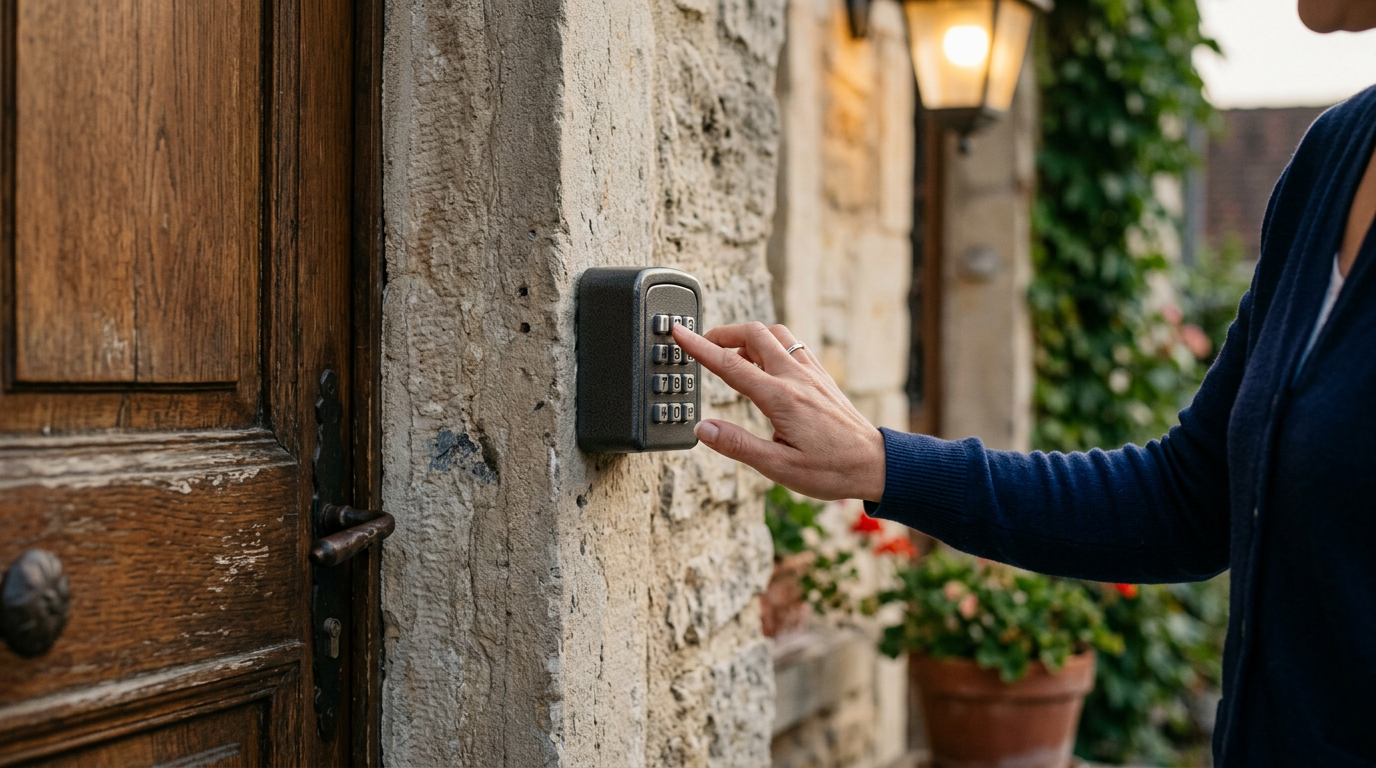
It’s 11 pm. Your guests have been driving for six hours, the child is asleep in the back, and the phone shows 8 per cent of its battery remaining. They’re standing at your front door and can’t find the key box.
This is exactly the scenario that self-service check-in is supposed to prevent, and yet it’s the very scenario it creates when it’s not properly set up. The good news is that failure is very rarely down to the equipment. It’s almost always down to the instructions.
Self-check-in, in two sentences
Self-check-in, or self-arrival, refers to any system that allows a traveller to enter the accommodation without anyone handing them the keys in person. It relies on two inseparable components: an access system and a set of instructions.
Most articles on the subject deal only with the first. Yet it is the second that determines whether the arrival goes smoothly.
The three access systems, explained in plain language
The combination key box
The most common and cheapest solution, generally costing between 30 and 80 euros. It contains the physical key and is opened using a code that you give to the guest. Simple, with no fragile electronics, but it requires some discipline: change the code after every stay. This is the most common oversight, and it turns your key box into a permanent master key for all your previous guests.
The smart lock
Expect to pay between 150 and 350 euros. The guest receives a unique numeric code, valid only for the duration of their stay, and it expires automatically. This offers maximum convenience, but with two drawbacks that shouldn’t be overlooked: a reliance on the power supply and, at times, the network, and an installation that isn’t always possible in block-of-flats.
The building or gate access code
Where one already exists, it simplifies everything. Be careful, however, with codes managed by the property manager, which sometimes change without you being notified. An out-of-date building code in your instructions is a guaranteed phone call at 11 pm.
You can choose the equipment in an hour. What sets a good self-check-in apart from a bad one lies elsewhere.
Why a self-check-in really fails
When you receive a panicked call, trace the cause. In the vast majority of cases, it isn’t the lock that’s failed. It’s one of these five situations.
- The traveller can’t find the device. You know the box is ‘to the right of the gate’, because you’re familiar with the premises. They’re faced with a blank façade in the dark.
- The instructions are in an email thread. Sent three weeks earlier, they’re buried under forty messages. Nobody scrolls back through an Airbnb thread when their battery’s down to 8 per cent.
- The code has changed and the information hasn’t been updated. This is common after a change of property manager or a reset of the box.
- The instructions aren’t understood. A foreign traveller faced with a text in French alone has to make do with an automatic translator, in the dark, in the rain.
- There’s no plan B. The box is locked, the lock’s battery’s dead, and the guest has no idea who to call.
Writing arrival instructions that work
Here are the rules that make all the difference, in order of importance.
Show the final metre in a photo
This is the most valuable piece of advice in the whole article. A photo of the front of the house with the key box clearly visible is worth three paragraphs of description. Add a night-time shot, as it’s in the dark that the problem arises.
Number the steps, one action per line
No descriptive paragraphs. A series of short instructions: turn right after the bakery, green gate, grey box at shoulder height, enter the code, turn the dial downwards.
Write as if for someone who’s never been there
Avoid landmarks that only locals would recognise. ‘Opposite Martine’s’ means nothing to a Dutch person. Use a precise address, a house number or a door colour instead.
Plan for the night-time version
The timer for the outdoor lighting, the switch in the hall, the position of the entrance light switch. These are details that are trivial by day but can prove a hindrance at night.
Translate
Directions written solely in French are only useful for some of your guests. Machine translation solves the problem effortlessly, and we explain how it works in our guide to the multilingual welcome booklet.
Plan B is not optional
Every system eventually breaks down at some point. The difference between a minor incident and a 2-star review comes down to what the traveller finds at that moment.
- A contact number, clearly identified as the point of contact in the event of an access issue.
- A backup solution: a spare key with a neighbour, a local shopkeeper or a partner concierge service .
- A message giving permission to call. Many guests don’t dare to disturb anyone. State explicitly that a call is normal and expected if they’re locked out.
A traveller who knows who to call won’t panic. A traveller who doesn’t know will leave a review.
Self-sufficient doesn’t mean impersonal
The most common fear amongst owners of holiday cottages and B&Bs is legitimate: by doing away with the key handover, aren’t we doing away with the welcome itself?
In practice, self-check-in mainly removes a constraint for both parties. The traveller no longer has to plan their journey around your availability. You no longer have to wait two hours in a car because the train is delayed.
What replaces the handshake is the care taken over what the traveller discovers upon entering: a welcome note, welcome, recommendations that only you know about, and explanations of how the property works. This is precisely what we discuss in our article on the importance of the welcome in short-term rentals.
How to bring your arrival instructions to life
You now have well-written instructions, photos, a plan B and a translation. That leaves the question of the medium, and this is where many owners lose all the benefit of their hard work.
A message sent the day before has the advantage of arriving at the right time, but it gets lost as soon as another exchange takes precedence. An attached PDF needs to be downloaded, which nobody does whilst walking down a dark street. The paper version, meanwhile, is inside the accommodation, so it’s of no use at the very moment the traveller needs it.
A digital welcome booklet solves the problem for one simple reason: it consists of a single link and a QR code; it opens in two seconds on the traveller’s phone, which they already have in their hand, and you can update it at any time. When the gate code changes, you simply edit a line, and the information is immediately up to date for everyone.
It’s also the natural place to bring together everything that happens after arrival: Wi-Fi, how to use the facilities, and departure instructions. If you’re just starting out, our article on the best practices for welcome booklets details the structure you should adopt.
Frequently asked questions about self-check-in
Is self-check-in a security risk for the property?
The main risk isn’t the device itself, but the code being left unchanged from one stay to the next. Change it every time, or opt for a smart lock that generates a unique code for each booking.
Which system should you choose when starting out?
A code-operated key box, without a doubt. It costs a few dozen euros, can be installed in half an hour and does not rely on a network or a battery. You can switch to a smart lock when the volume of arrivals warrants it.
Can I install a key box in a block of flats?
That depends on the regulations and the proposed location. A box fitted in a communal area may be contested. Check with your property manager before installation.
Is an inventory of fixtures still required?
For short-term rentals, a formal inventory isn’t always required. Many owners rely on a photo inventory taken by the guest and a security deposit. We explain how this works in our article on security deposits for short-term rentals.
Does self-check-in lower guest ratings?
Not in itself. What brings ratings down is a guest being locked out or left without information. A well-organised self-check-in is often rated higher than a haphazard in-person welcome, because it also offers greater flexibility regarding arrival times.
In summary
The access equipment is the easy and least expensive part. What determines the success of a self-check-in is the quality of the instructions, their availability at the right time and the existence of a plan B.
With Guideo, you can bring together access instructions, photos, emergency contacts and stay details in a digital welcome booklet shared via a link or QR code, which is translated automatically and can be edited in seconds from your dashboard.